
“Vodka has a neutral taste. Arak tastes of anise.”
This sentence was a response provided within a cross-examination at the heart of a complex trademark dispute involving four oppositions and a motion to cancel an existing registration.
We obtained a significant victory for our client, ZHS IP Worldwide Sàrl, aka STOLI, before the Israeli Trade Marks Registrar.
The proceedings included extensive documentary evidence, expert opinions, consumer surveys and cross-examinations. They raised important questions concerning well-known trademarks, the relationship between vodka and arak, and the evidentiary value of consumer surveys.
One of the most memorable exchanges took place during Eran Soroker’s cross-examination of the Israeli producer manager.
Eran asked whether a customer could order vodka in a bar, receive arak instead, and fail to notice the difference.
The Israeli producer manager replied: “I hope not.”
He then confirmed that vodka has a neutral taste, while arak has the distinctive taste of anise.
The Deputy Registrar quoted this exchange in the decision. It was not merely an entertaining moment during the hearing. It addressed the commercial reality at the centre of the case. The clear difference in taste between the products supported the conclusion that the likelihood of confusion was low. Thus, it turned from an entertaining quote to a decisive one.
While deciding that ELITE HA’ARAK is a well-known trademark in Israel and that arak and vodka are goods of the same description, it ruled against the Israeli manufacturer.
The Deputy Registrar decided that Stoli’s ELIT marks were not confusingly similar to ELITE HA’ARAK marks.
The Deputy Registrar applied the Israeli, case law based, triple test. He examined the visual and phonetic similarity between the marks, the nature of the goods and the relevant consumers, and the other circumstances of the case.
While he acknowledged a significant phonetic similarity between ELIT and ELITE, he found that their look was sufficiently different.
ELITE HA’ARAK marks consist of the combinations ELITE HA’ARAK and ARAK ELITE. The word “elite” is laudatory and refers to quality. The word “arak” is the generic name of the product. The Deputy Registrar held that the Israeli manufacturer could not appropriate the word ELITE and prevent others from using that word, or a similar word, as part of a different trademark.
The Deputy Registrar observed that the well-known status of ELITE HA’ARAK gave the Israeli manufacturers a right to register its marks. It did not give him an absolute monopoly over the word ELITE.
We further argued that Stoli uses the word “elit” without the letter “e”. It uses lowercase letters and distinctive fonts. Some of the applications include additional graphic elements, such as a flame within a triangle, the word EIGHTEEN, or the three-dimensional design of the ELIT vodka bottle.
We argued that the Israeli manufacturer’s labels create a very different visual impression. They include several textual and graphic components, prominent colours, frames and images of deer.
The Deputy Registrar accepted our arguments and found that the differences in spelling, design and overall presentation were clear and significant. He concluded that the marks, viewed in their entirety, were not confusingly similar.
The Deputy Registrar accepted our arguments that the way the products are presented in the market reinforces the conclusion that the marks are not confusingly similar. The bottles, labels, colours and overall designs are substantially different. The Israeli manufacturer mainly uses Hebrew branding, while Stoli’s marks appear in English. These differences further reduced the likelihood of confusion.
The decision rejected the Israeli manufacture’s allegation that Stoli had acted in bad faith. The evidence showed that the ELIT vodka brand had been used internationally since 2003 and had also been marketed in Israel. The Deputy Registrar found it implausible that Stoli had selected and launched its international brand in order to benefit from the reputation of ELITE HA’ARAK in Israel.
The Israeli manufacturer relied on a consumer survey. The Deputy Registrar accepted our arguments and identified material flaws in its methodology, including the wording of the question, the presentation of the mark outside its commercial context and the absence of control questions. He therefore gave the survey extremely low weight and held that it did not establish a likelihood of confusion.
The Israeli manufacturer was ordered to pay Stoli NIS 15,000 in legal fees and expenses.
This is an excellent result for our client. It is also a thoughtful and interesting decision in Israeli trademark law.
The decision shows that recognition of an earlier trademark as well known is important, but it is not the end of the analysis. Even a well-known trademark does not necessarily give its owner exclusive rights over every descriptive or laudatory element contained within it.
The marks should still be assessed as a whole. Their visual and phonetic features, overall presentation and commercial context all matter.
We are happy that the final result was a clear victory for Stoli. We now know that a direct question about the difference between the taste of vodka and the taste of arak can win a case!
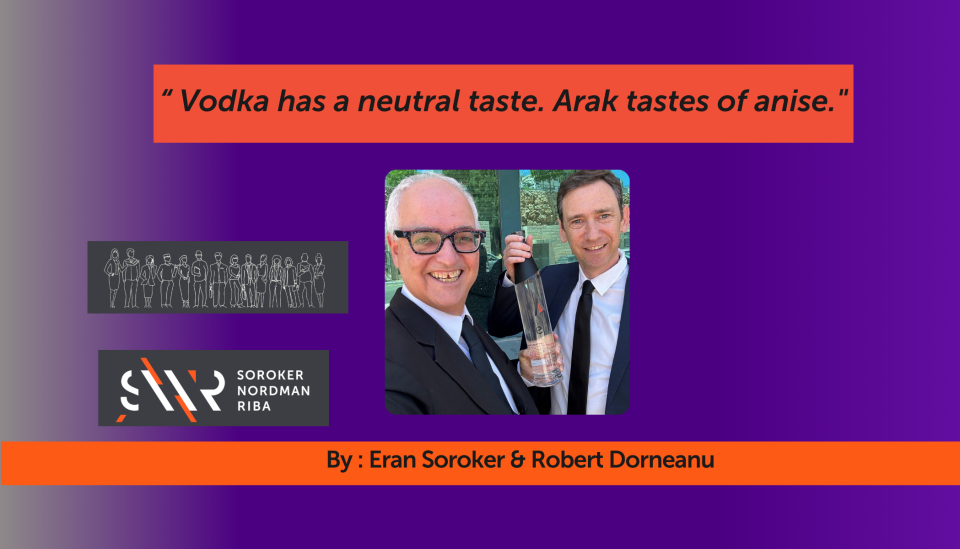
Pictured: Eran Soroker and Robert Dorneanu following the hearing, together with the ELIT vodka bottle at the center of the dispute.